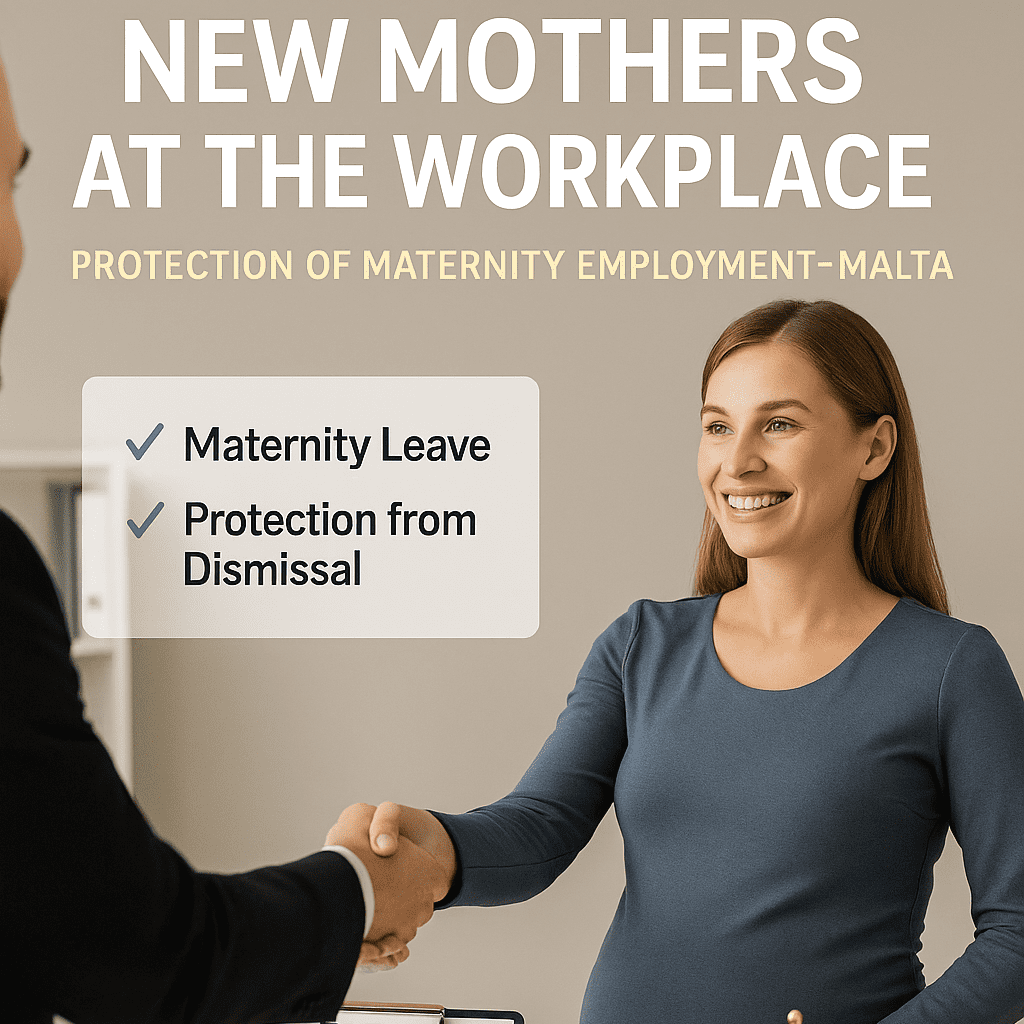
The Protection of Maternity (Employment) Regulations (S.L. 452. 91) establish essential provisions which are aimed at safeguarding rights of women during pregnancy, after childbirth, and while breastfeeding. These regulations, along with the Employment and Industrial Relations Act, offer a comprehensive framework designed to safeguard the new mothers at the workplace. They outline specific protections of the new mothers while also detailing the responsibilities of employers to ensure these rights are properly upheld.
THE PREGNANT EMPLOYEE
Under Maltese Law, a Pregnant Employee is defined as “‘an employee who informs her employer in writing of her pregnancy and who subsequently, within fifteen days, formally informs her employer of her pregnancy and of the expected date of confinement by means of a certificate issued by a registered medical practitioner or midwife”.
MATERNITY LEAVE
A pregnant employee is entitled to eighteen (18) weeks of maternity leave. To benefit from this entitlement, the pregnant employee must notify her employer in writing whilst also specifying her the expected day of confinement by a certificate issued by a medical practitioner or midwife. Moreover, the expected start of leave has to be specified.
Payment during maternity leave is divided as follows:
i. The first fourteen (14) weeks are paid by the Employer; and
ii. The last four (4) weeks are paid by Government Social Benefits.
PROTECTION FROM DISMISSAL
Once a pregnancy is formally notified through a medical certificate, the employee should not be dismissed during the maternity leave. Dismissal during this period is prohibited unless there are justifiable grounds, which must be communicated in writing to the Department of Industrial and Employment Relations.
PROBATION
If maternity leave begins before the completion of the probationary period, the probation is effectively suspended for the duration of the leave.. For dismissal during probation to be justified, the employer is obliged to provide a written justification. Should the reason be deemed unjust, the employee may seek redress through the Industrial Tribunal for Unfair Dismissal.
DURING THE PREGNANCY
Throughout the pregnancy, the employer is obliged to preserve the employee’s job and wages. In cases where a safe working environment cannot be secured, the employer must offer Special Maternity Leave. During this period, the employee retains all her employment rights and entitlements.
ANTE-NATAL CARE
All pregnant employees are entitled to paid time off to attend ante-natal clinics for medical appointments. This right is conditional upon the employee providing evidence of the appointment.
OCCUPATIONAL HEALTH AND SAFETY
The Protection of Maternity at Work Places Regulation (S.L. 424. 11) imposes additional duties on employers to assess the workplace environment which may affect pregnant employees. The Employer must:
- Conduct a risk assessment;
- Provide temporary adjustments to the work environment or duties; and
- Reassign the employee to suitable alternative tasks and job if necessary.
WORK LIFE BALANCE REGULATION
The Work Life Balance Regulation (S.L. 452. 125) is of recent introduction and grants additional rights to promote flexibility and support working parents. These include:
- Paternity Leave
This allows the father or equivalent second parent ten (10) days of paid leave, to be taken immediately after childbirth.
- Parental Leave
This grants each parent the right to four (4) months of leave until the child reaches eight (8) years of age. The first two (2) months are paid at the sickness benefit rate under the Social Security Act.
- Carers’ Leave
This grants five (5) days of unpaid leave per year to care for relatives or household members requiring medical care.
Additionally, employees with children under eight (8) years of age or those with caring responsibilities also have the right to request flexible working hours.
BACK TO WORK
Upon returning back to work, the mother has the right to return to her previous position, or if that is not feasible, to a comparable role consistent with her employment contract. The rule to be followed is that an employee who has taken maternity leave must return back to work for a minimum period of six (6) months.
In essence, the Maltese Legal System provides a robust framework of protections for pregnant and new mothers at the work place. These laws not only guarantee a safe working environment and job security but also ensure the continuation of employment rights and benefits. Ultimately, the responsibility lies with the employer to uphold these rights and safeguard both the employee and the unborn child throughout the maternity period.
For more information you can contact one of our Team Members at Mifsud & Mifsud Advocates.